Wait Step
Wait Steps are used to manage the cadence of your Journey. They hold the customer at that point of the Journey for a defined period before proceeding to the next step, such as waiting a week before sending a reminder message.
With Wait Steps, you can:
-
Set a fixed wait duration
-
Personalize the wait for an individual customer
-
Finish the wait early if a customer exhibits engagement behavior
-
Report on where in your Journey you are getting most traction
Add a Wait Step to your Journey
From your Journey canvas:
-
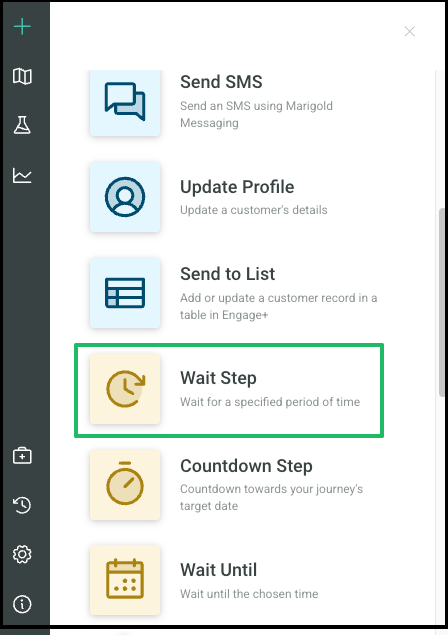
Click + in the top left corner; this will display the steps available to add to your canvas.
-
Select Wait Step from the available options.
-
Drag and drop to your desired spot in the Journey canvas.
Connections
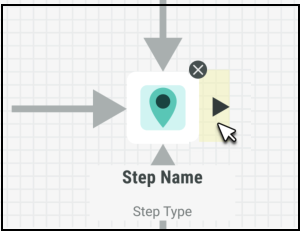
The simple connector mechanism allows you to create complex workflows with clearly defined relationships between each step. When connecting elements, every step can have both inbound and outbound connections.
To create connections:
-
Hover over a step's edge to display an arrowhead.
-
Click and drag to the next step, and release to create a connector.
-
To label a connector, click it and add a name in the Edit Pane.
-
Use the Label Position slider to adjust label placement as needed.
Configuring the Wait Step
To configure this step, click on the icon in the canvas. This will open a panel on the left hand side of your screen with the associated settings where you can begin filling out each field accordingly.
Once complete, either click Save in the top right hand corner of your screen to save your changes and exit the Journey, or click Apply to save and continue updating the Journey.
Set the Duration
Wait Duration is a fixed amount of time that a customer will wait until proceeding to the next step.
-
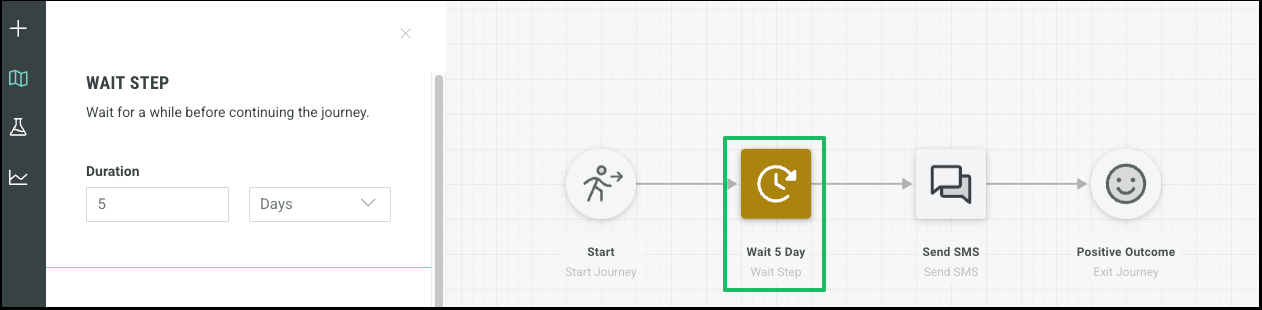
Click on the Wait Step to open the left hand panel.
-
Enter the duration for the step to wait before moving to the next step in the Journey.
-
Choose the unit for the duration entered (minutes/hours/days/weeks)
Once you have configured the duration, the name of the step will update automatically to the duration you have set.
The set duration time is not applicable to customers who have the Early Exits and Personalized waits configured
Personalized Waits
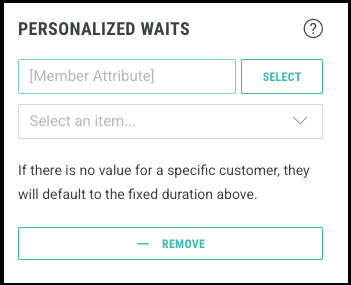
You can use personalized waits to replace the default wait time with a tailored duration based on a customer specific data or events. You can select an attribute from the customer database table or event attributes to personalize the experience.
Hover over the Add Personalization button and either Member attributes or Event attributes.
Note: If there is no specific value for a customer, the wait duration will default to the fixed duration set above.
The available attribute types include:
-
Member attribute – You can define the wait duration based on the personalized attributes from your Journey's source table that contains customer-specific data. This table is defined in your Journey Settings.
-
Click Select to bring up the list of table attributes from your Journey's source table.
-
In the displayed Select a Table Attribute pop up window, click on the desired attribute and then click Select.
-
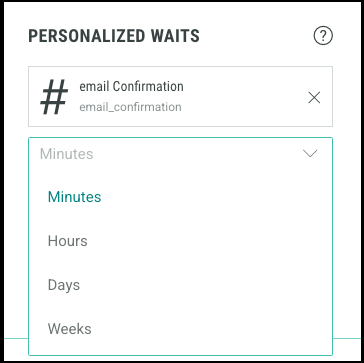
Choose the unit for the wait duration (minutes/hours/days/weeks).
-
-
Event attribute – You can define the wait duration based on the event attributes from the events used in the Journey.
-
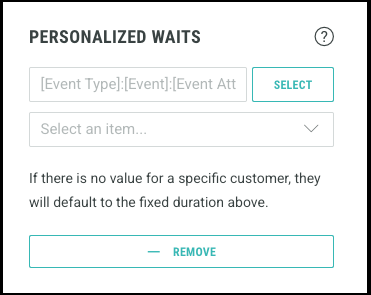
Click Select to bring up the list of Events used in the Journey.
-
Find your desired Event then click Select.
-
In the displayed Select a Event pop up window, click on the desired event from the list and then click Next.
-
Then select the desired event attribute from the list corresponding to the chosen event and then click Select.
-
Finally choose the unit for the wait duration (minutes/hours/days/weeks).
-
Early Exits
As a marketer, early exits provide valuable opportunities to optimize customer Journeys based on their engagement. When a customer takes a specific action during a wait period (such as clicking an ad link), you receive a clear indication of heightened interest. This allows you to create more responsive Journeys that adapt to customer behavior in real-time, rather than forcing all users through the same fixed timeline.
They can then proceed along the regular path or take an alternate path designed for those who performed the action.
Early exits can help streamline customer Journeys by allowing engaged users to progress more quickly, improving overall experience and conversion rates. You can configure triggers based on:
-
Customer actions (purchases, form submissions)
-
Engagement (clicks, opens)
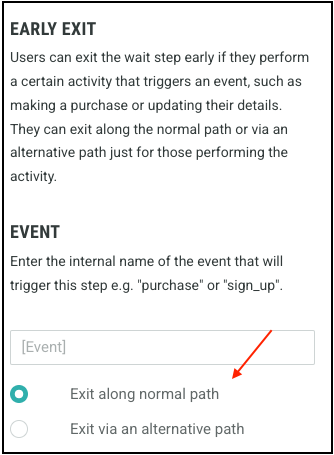
By default, the wait step is set to “Exit along normal path”, meaning the Journey will continue as usual after the wait. If you want the step to be exited before the set duration, select “Exit via an alternate path”. You can create an alternative exit path by drawing a second exit from the wait step.
Event
In this field, you can define which customer event will trigger this Step. Customers will move through this Step in the Journey as they perform the event related action in real-time, such as making a purchase or signing up.
Whenever a customer performs certain actions in Zeta applications and your other integrated marketing platforms such as websites, they are identified as Events. Journeys waits to be told about these events by the other Zeta apps, like Cheetah Digital and Interactive Moments. These apps are known as Producer apps.
The Producer apps need to be configured to send the event data to Journeys based on the occurrence. These producer apps need to be configured to send data to Journeys based on a trigger. Journeys will receive Event data whenever a customer performs an action that triggers an event, and accordingly the customer is placed at the start or taken to alternate paths in the Journey.
Events can be used to place a customer into a Journey, guide them to an alternate path within a Journey, or even have them start another Journey based on their actions. Journeys provides a predefined list of common events for you to choose from. Similar events (e.g., a purchase) are grouped into event types.
You can configure your Journey steps to be based on these predefined Events and take the customer through an intended path to exploit opportunities based on the customer behavior.
Note: Ensure that an Event Map with this event type is available in Cheetah Digital, and Moment is available in Interactive Interactive Moments, based on the application selected for the Journey. Without the corresponding Event Maps and/or Interactive Moments (based on your app selection), your Journey will not start or function as intended.
Note: When configuring your Journey Settings, you can have your Event Subscriptions set to either Subscribe Automatically or Use Webhooks. Based on this selection, the method for selecting your events in the Step will differ. Refer to Journey Settings for more details.
Events from ZetaEvent Stream (Subscribe Automatically)
You can use events from multiple event sources, specifically, the applications selected in the App Selection field within the Journey's settings. To do this, you'll first need to configure the necessary settings in your source applications.
Cheetah Digital:
To use event data from Cheetah Digital, you must first configure your Event Maps. These maps make event data available to Journeys based on the configured triggers.
When you set your Journey's Event Subscription setting to Subscribe Automatically, it will subscribe to all the event data sent from Cheetah Digital.
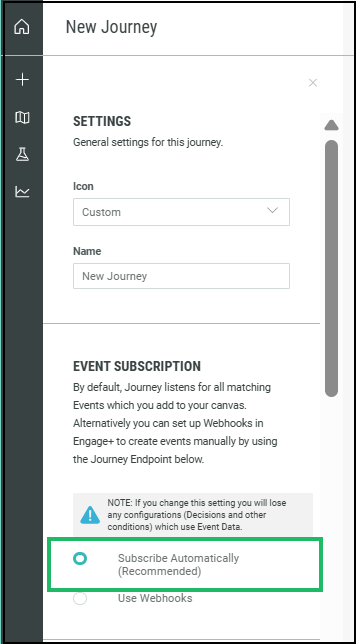
Based on the event data required for your Journey steps, you must select the appropriate event in the Event field within your Step settings.
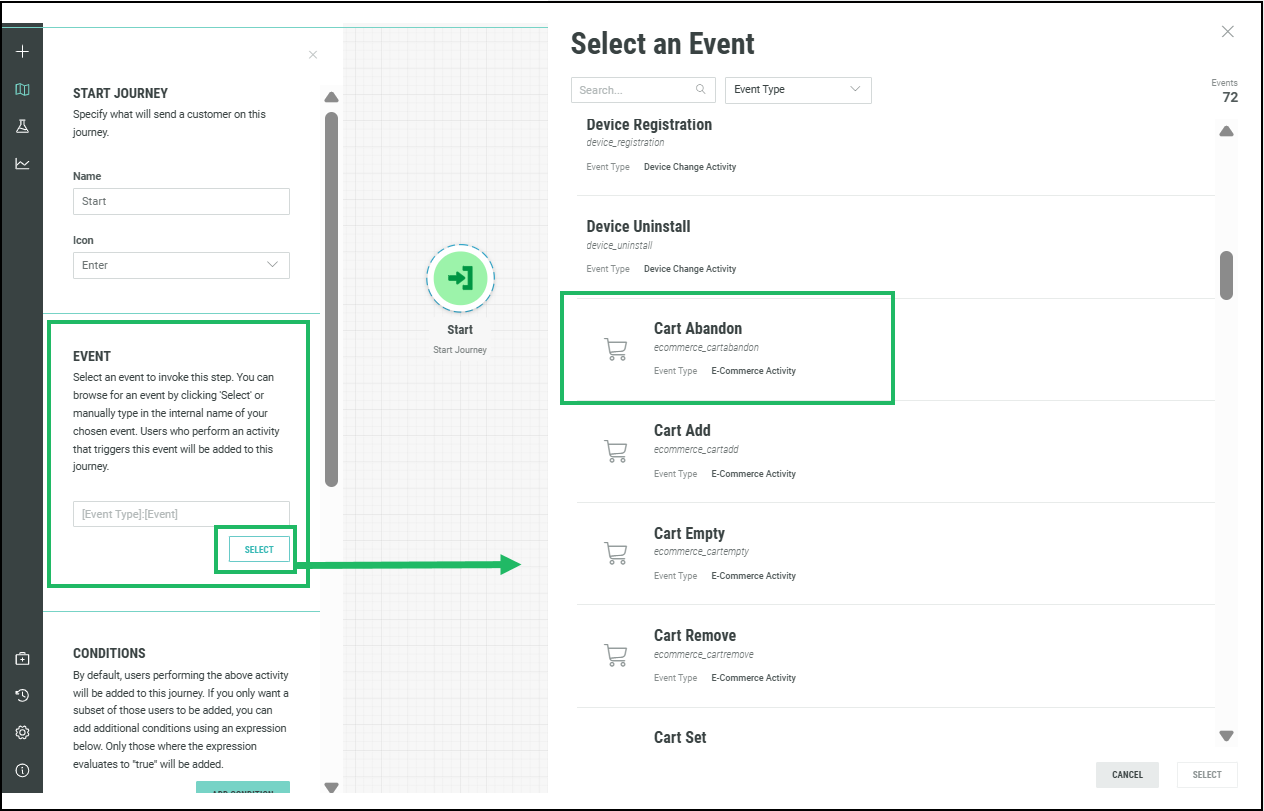
For this data to be available in your Journey, an Event Map with the same Event Type must exist.
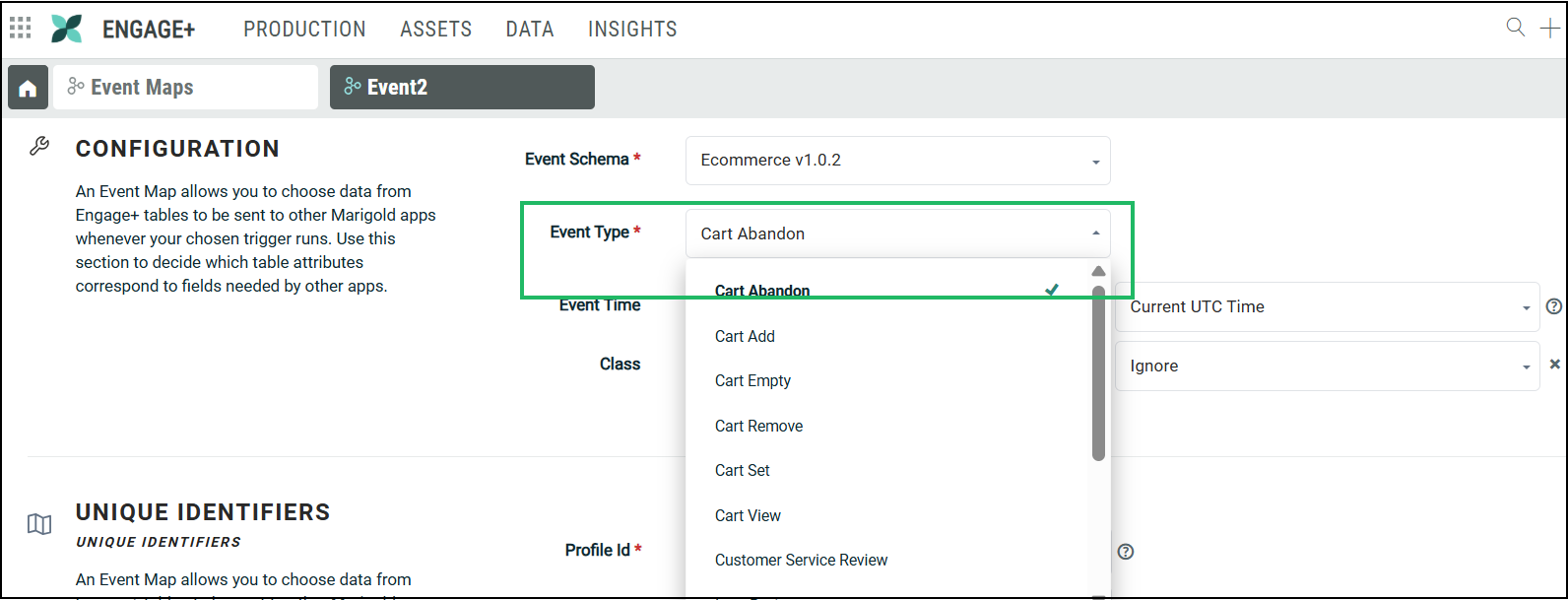
For example, to use the Cart Abandon event in the Start step of an Abandoned Cart Journey, you must have an Event Map created with the Event Type: Cart Abandon.
Note: You do not need to create a separate Event map for every Journey. You only need to ensure that an Event map with the required Event Type exists to send the appropriate event data from Cheetah Digital. Once this data is available, it can be used across multiple Journeys.
Similarly, you can have multiple Event maps linked to the same Event Type but configured with different conditions, such as different triggers or schedules. For example, different online stores can each have their own trigger mapped to the same Purchase Event Type.
Contact your Zeta representative to provision Event maps in your account, and set up the necessary Event Schema and Event Types.
To create your Event maps, refer here for instructions.
Interactive Interactive Moments: To use events from Interactive Interactive Moments application, you must first configure your Interactive Moments. These Interactive Moments listens for specific signals and triggers a pre-defined response based on the information contained within those signals. A Moment defines “when” and “how” actions are executed, like sending a notification or an email 2 hours after the cart was abandoned.
Refer Interactive Moments for more details.
To select your Events when your Journey is set to Subscribe Automatically, for Event Subscription:
-
In the Event field, click Select to open the list of events to choose from.
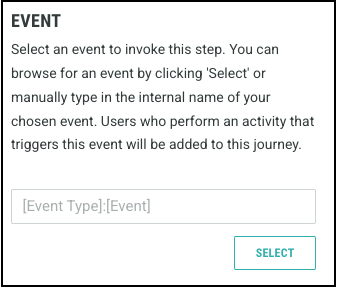
-
In the displayed popup window, select the event you want the step to be associated with. You can also use the search option to find an event from the list.
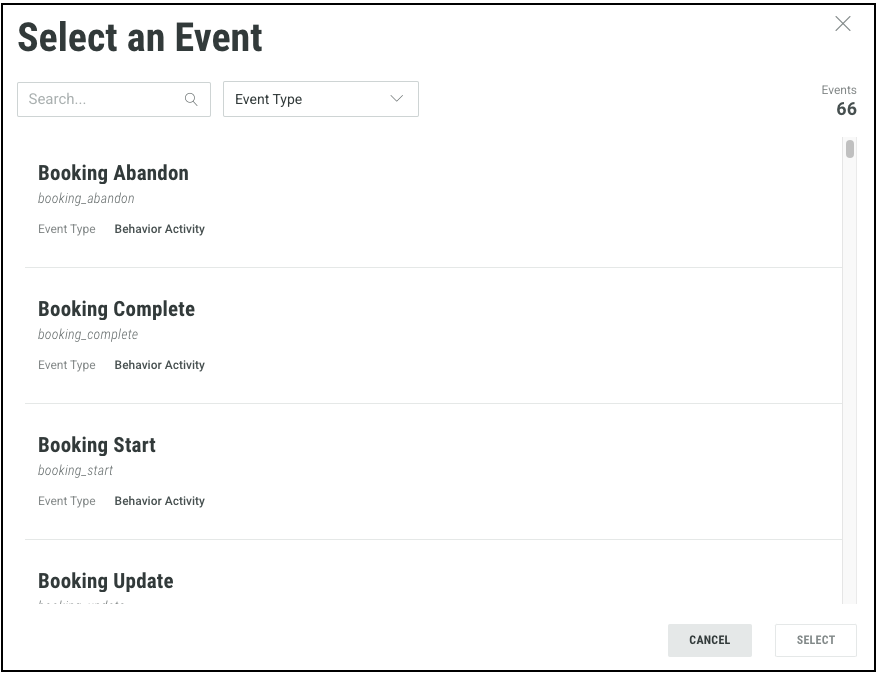
Alternatively, you can use the Event Type to filter the events. An Event Typerepresents a group of similar events. Most of the events that can be used in your Journey Steps are available in these Event Types: E-Commerce Activity, Campaign Activity and Profile Sync Activity.
-
Click on your preferred event and then click Select.
Events from Webhooks
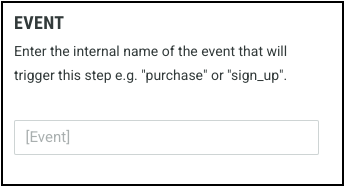
If your Event Subscription is configured to use Webhooks, ensure that the corresponding Webhooks are created within Cheetah Digital to transmit event data to Journeys. You will need to manually enter the event name exactly as it appears in the JSON payload defined within the Cheetah Digital Webhook.
Note: The Journey uses events from your selected applications (Cheetah Digital, Interactive Interactive Moments). By default this is set to all of the applications available on your account.
Note: You can select the application to align with your specific needs and objectives, as this choice will determine the events you can access and track throughout your Journey. For more details refer to Journey Settings.
Adding Notes
Use the notes section to clarify the rationale behind your choices or to highlight any notes for other marketers using the Journey.